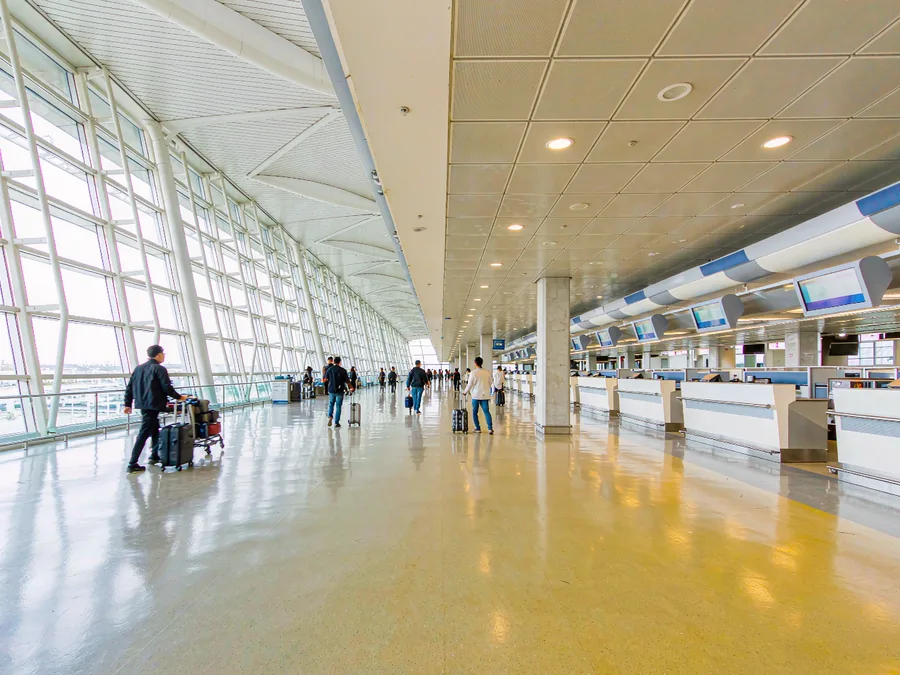
Transport buildings never empty. A concourse handles tens of thousands of people a day, half of them dragging wheeled luggage, plus cleaning machines, trolleys, delivery carts and the occasional maintenance vehicle. There is no summer holiday in which to replace the floor, so installation happens in night shifts, in sections, with the public walking past a few metres away — which means the adhesive system, the seam quality and the cure time matter as much as the decoration.
Slip is the specification driver, and it has to be read in the wet condition. Entrances and gate lines take rainwater and melted snow; platforms take spills and cleaning water; ramps and stairs take the worst combination of slope and moisture. We look for R10 to R11 with a textured surface that still cleans, because a deeply profiled anti-slip floor traps dirt and becomes a maintenance problem of its own. Directional needle-punch patterns and matte finishes also hide the scuffing that luggage wheels leave in the first week.
Public buildings also bring compliance into the brief: fire class for means of escape, low emission for enclosed concourses, and slip classification that the operator's insurer will ask for. A 2.0–3.0 mm homogeneous sheet in a welded installation answers most of it — it can be repaired by cutting out a section and re-welding rather than replacing a whole bay, which in a station is the difference between a night's work and a week's closure.
- Typical areas: concourses, platforms, ticket halls, transfer passages, ramps, stairs, back-of-house corridors
- Usual specification: 2.0–3.0 mm homogeneous, welded, R10/R11 with cleanable texture, Bfl-s1
- Installation: night shifts in sections, low-odour adhesive, walk-on time agreed with the operator
- Repair strategy: cut out and re-weld damaged areas, keep attic stock of the same batch
- Entrance zones: matting system plus a darker, denser floor for the first metres to trap grit and water
Project references
Scenes in use
จุดเด่นของสินค้า