



Q&A
Commercial Floor Q&A
The questions that come back most often from contractors, distributors and facility managers — answered the way we would answer them on the phone, without the brochure language.
Choosing the right floor
Homogeneous or heterogeneous sheet — how do I choose?
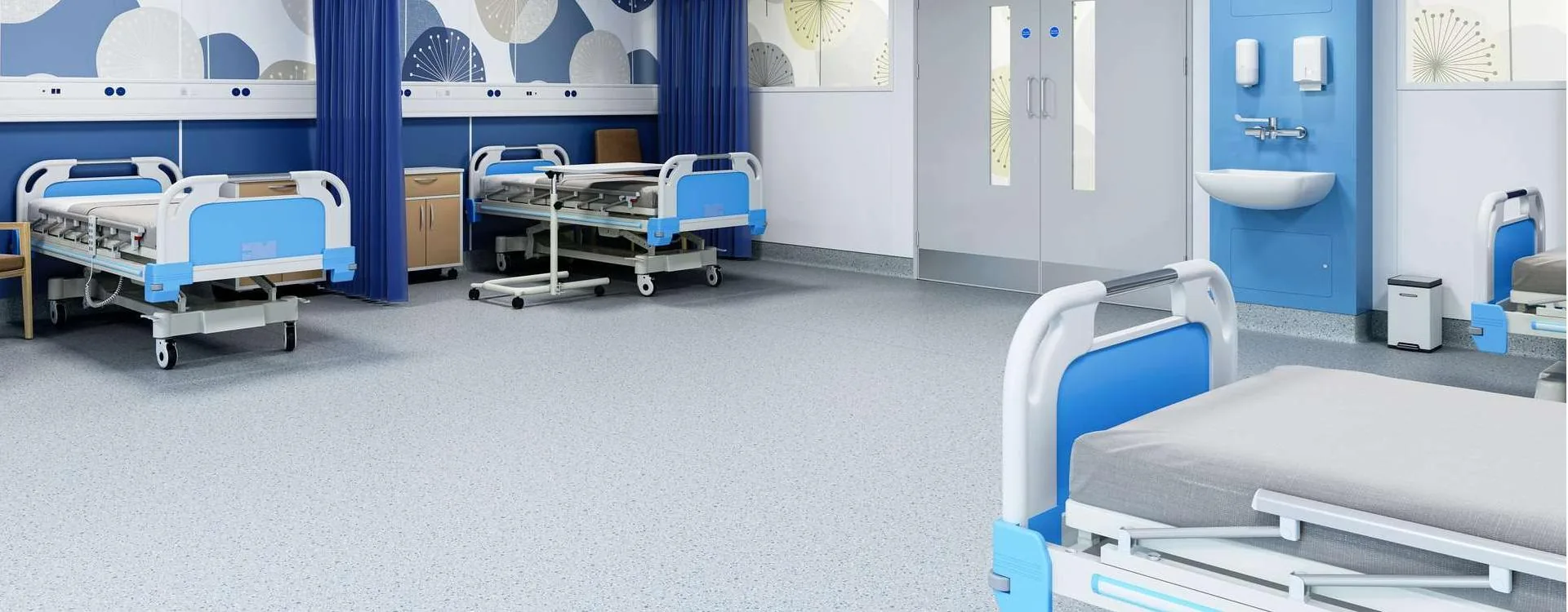
Homogeneous means the colour and pattern run through the full thickness, so wear does not expose a different layer underneath. It is the right choice where the floor will be scrubbed, disinfected, or used hard for fifteen years — hospitals, schools, transport, laboratories.
Heterogeneous sheet puts a printed design under a transparent wear layer, which gives far more design freedom and a lower price at the same thickness. Where appearance drives the decision — offices, retail, hospitality — it is usually the better answer.
- Choose homogeneous if: heavy cleaning, long service life, seamless hygiene, or the client wants one finish across future refits.
- Choose heterogeneous if: design range, budget, or a short-to-medium fit-out cycle.
What wear layer does a school corridor need?
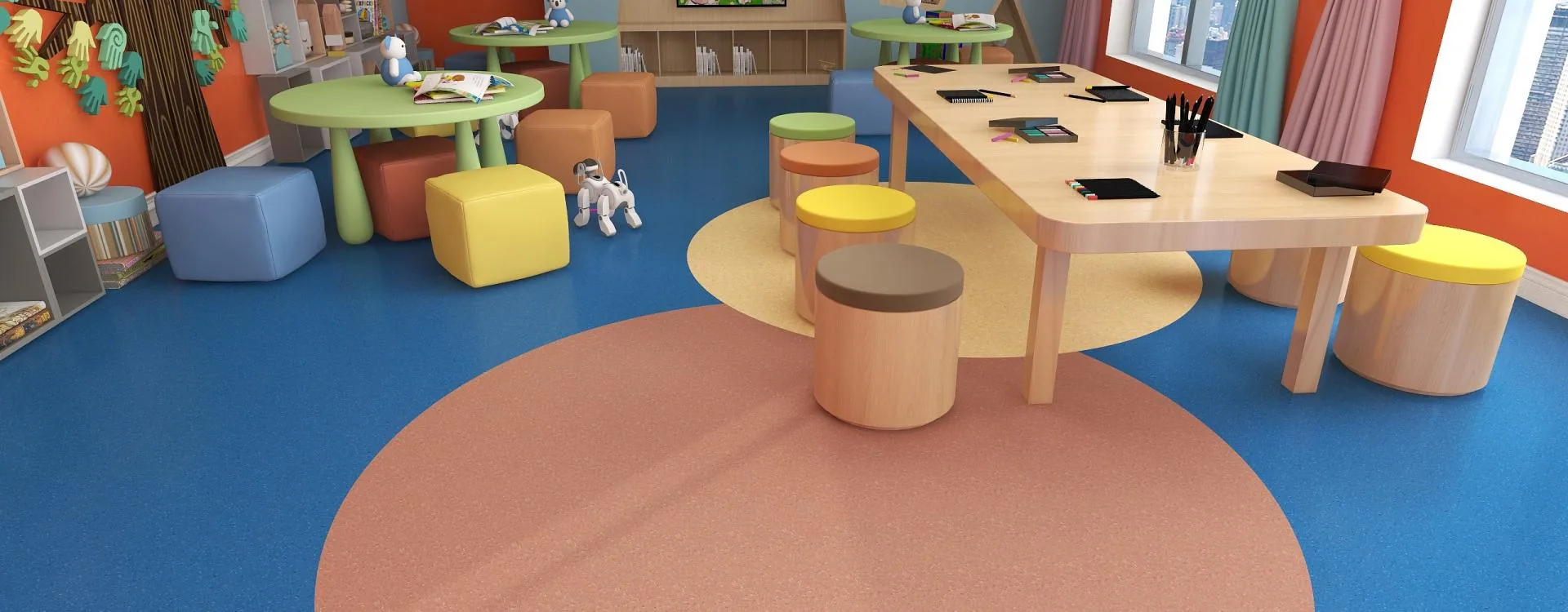
For a secondary school corridor we would normally specify 0.7 mm, or 2.0 mm homogeneous. The corridor is the single hardest-wearing area in the building: it takes every pair of shoes in the school, twice a day, plus cleaning machines and the occasional trolley.
Classrooms can usually drop to 0.5 mm. Spending the difference on the corridor instead of upgrading every room is normally the better use of the budget.
Is SPC good enough for a commercial project?
Yes, where the brief suits it: retail, offices, clinics, hotel guest areas, and any space that needs fast installation over a sound substrate. SPC is rigid, clicks together without adhesive, and tolerates being laid and used the same week.
It is not the right answer for wet rooms, kitchens with floor drainage, or areas that must be seamless and coved. Those need welded sheet.
What do R10 and R11 actually mean?
They come from the ramp test in DIN 51130: a person walks up and down an oiled ramp that gets steeper until they slip. R10 corresponds to roughly 10–19°, R11 to 19–27°. It describes grip under contamination, not dry-room friction.
Practical mapping: R9 for offices and dry circulation, R10 for entrances, canteens and school corridors, R11 for commercial kitchens and wet production areas, R12+ for ramps and wash-down zones.
Can the same floor run from a kitchen into a corridor?
It can look continuous and still be two different products — the usual solution is a slip-resistant sheet in the kitchen and a smoother sheet in the corridor, joined with a welded transition rather than a profile. Same colour family, different slip rating.
If the kitchen has floor drains and daily wash-down, keep it as a separate, fully welded and coved zone with its own falls. Trying to save one seam there usually costs more later.
Substrate and installation
What moisture level must the slab be at?
As a rule of thumb, cementitious screeds should read below 2.5% CM (or roughly 75% RH) before a moisture-sensitive adhesive is used; for anhydrite and heated screeds the limit is tighter, around 0.5% CM. Below-grade slabs need a surface damp-proof membrane regardless of the reading.
Test rather than assume — a slab that looks dry can still be releasing moisture, and a failed adhesive bond is expensive to put right.
Do I always need a smoothing compound?
Not always, but more often than clients expect. Homogeneous sheet shows every ridge and trowel mark, so it needs a flatter substrate than tile does. A 2–3 mm compound over a sound, primed slab is often the cheapest part of the whole installation relative to what it prevents.
SPC is far more forgiving: many click ranges will bridge minor undulations, provided the substrate is flat within the manufacturer's tolerance over a 2 m straightedge.
How soon can the floor take traffic?
With a standard adhesive, light foot traffic after 24 hours, rolling loads after 48–72 hours, and welding after the adhesive has fully set (usually the next day). Fast-curing adhesives shorten this, but not to zero.
SPC click needs no waiting for adhesive at all, which is why it is often chosen for occupied buildings and weekend refits.
Can it be installed over existing vinyl?
Sometimes. The existing floor must be well bonded, flat, clean and free of wax or polish; single-layer vinyl can often stay, cushioned or foam-backed vinyl usually cannot. Always test the old adhesive for asbestos in buildings from before the mid-1980s.
If in doubt, remove it. A new floor laid over a failing one fails with it.
Maintenance and repair
What maintenance does a PUR surface actually need?
Less than most people expect, provided the first weeks are done properly: dry-mop daily, damp-mop with a neutral cleaner, and no aggressive stripping agents. The factory treatment is not a permanent coating — it is a treatment, and abrasive cleaners wear it away faster than traffic does.
In heavy-traffic areas, a maintenance emulsion applied once or twice a year restores the surface and makes the next ten years of cleaning easier.
Can a damaged area be repaired without replacing the room?
Yes. A welded seam makes local repair practical: cut out the damaged piece on seam lines, insert a matching patch, groove and weld, then trim flush. On a homogeneous floor the repair becomes almost invisible after a few weeks of traffic.
Keep 5% of the order as attic stock for exactly this purpose — it is the cheapest insurance in the whole project, and matching a colour three years later is never guaranteed.
Are dark colours harder to keep clean?
Yes, and it is worth saying plainly. Dark matte floors show dust and footprints within hours; very light floors show every scuff and hairline scratch. Mid-tone, low-contrast patterns hide both best — which is why most hospitals choose them.
Entrance matting does more for appearance retention than any choice of colour.
Ordering and logistics
What is the minimum order?
For stock references, one pallet — which is also the practical minimum for a mixed container. For a colour produced to order, the minimum is normally one production run per reference, quoted case by case.
Samples are free; the client covers courier.
How do you calculate wastage?
Per laying method, not as one flat percentage. Straight lay in a large open area is typically 5–7%; diagonal lay 10–12%; herringbone and small, divided rooms can reach 15%. Cutting across a pattern repeat costs more than cutting along it.
We send the calculation with the quotation so the quantity can be checked before the order is fixed.
What documents come with a shipment?
Commercial invoice, packing list, and the technical data sheet for the exact reference shipped. Test reports (fire, slip, emissions, static), the CE declaration where applicable and the installation guide are issued as PDFs with the order confirmation, so they reach the project team before the container does.
If a project needs certificates in a specific name or with an apostille, tell us at order stage — it cannot be added after the container has sailed.


Still stuck on a specific site condition? Send a photograph of the substrate with the question — it is usually faster than describing it.
تخطط لمشروع أو لمجموعة منتجات محلية؟
أخبرنا بالاستخدام وكثافة الحركة والسوق المستهدف، وسنساعدك في اختيار المنتجات والخطوات التالية.